Your CRM has always recorded what your reps typed. Outside of recorded service calls, it has never heard what your customers said. That gap is where deals quietly stall.
Momentum closes it. Salesforce acquired Momentum in March 2026 and has built it into Sales Cloud as its revenue orchestration layer. It turns every customer call, email and meeting into live data your AI-powered CRM can act on.
Picture a prospect mentioning on a call that they have a new CFO. It’s a throwaway comment, but it could change who signs off the deal. Your rep doesn’t catch it. Momentum does. It flags the change on the account, alerts the team in Slack, and gives Agentforce what it needs to suggest a next step.
Revenue orchestration turns conversations into CRM data
Revenue orchestration is Salesforce’s name for the layer in Sales Cloud that Momentum powers. It works in three steps: it captures every customer conversation, picks out the signals that matter for revenue, and helps your people and agents act on them.
It covers the whole revenue lifecycle, from first contact through to renewal and expansion. It is built natively on Salesforce, so everything lives in the CRM your teams already use.
Agents are only as useful as the context they work with
Structured CRM data tells you what stage a deal is at. The conversation tells you why it’s stuck.
Momentum captures that conversation. Its ingestion engine pulls in interactions from Zoom, Google Meet and Microsoft Teams, alongside email, text and calendar activity, and brings them natively into Salesforce. Agentforce and Slackbot can then use the customer’s actual words to drive multi-step workflows, rather than relying on whatever made it into a notes field.
For sales leaders, that is the difference between a record of what happened and an understanding of what is happening.
Your CRM updates itself
CRM Autopilot matches every conversation to the right account or opportunity and writes what the customer said back to the record, including the qualification criteria and competitor mentions your managers forecast from. The Momentum Notetaker joins the call, records it with attendee consent, and produces the transcript and summary automatically.
Your forecast stops depending on who remembered to type up their notes.
Every conversation becomes account memory
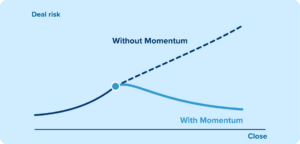
Momentum turns each conversation into persistent account memory, pulling out buying signals, risks and objections as they surface. That memory gives Agentforce the context to recommend next best actions or act on its own. It also feeds Deal Insights, which flags stalled deals, budget pushback and relationship gaps before they cost you the quarter.
What this means for your team: deal risk shows up while there is still time to fix it.
Leaders see the pattern, not just the pipeline
Most leaders never hear the calls. Momentum brings the calls to them. Executive Briefs land in Slack, drawing trends, risks and opportunities from hundreds of customer conversations. A sales director sees which objections are rising across the whole pipeline, not only in the deals they happen to review. Smart Clips share the key moments from individual calls, so product, marketing and customer success hear the voice of the customer directly.
Roadmap and messaging decisions start from what customers said, not from what got reported upwards.
Hunter takes on outbound
Pipeline starts with a seller researching accounts and chasing meetings. Hunter, Salesforce’s outbound sales agent, is built to take that work on. It is in pilot now, with general availability planned for November 2026. Hunter prospects, qualifies leads and books meetings autonomously. It also keeps pipeline current, surfaces renewal and expansion opportunities, and supports planning and forecasting. Your sellers keep the conversations that need a human.
Every one of these capabilities depends on how your Salesforce is set up underneath.
Momentum needs a map before it can drive
Momentum makes a lot of decisions for you, from which record a call belongs to and which fields to update, to what counts as a risk and who hears about it.
If one customer sits across three duplicate accounts, Momentum has to choose one. If “Negotiation” means something different in every team, the deal insights will too. The setup choices you make on day one shape everything it tells you afterwards.
Get the structure right first, and every conversation lands in the right place.
Get your implementation right from day one
Salesforce includes Momentum in the Core, Advanced and Max editions of Sales Cloud. The licence is the easy part. Making it work for your business is harder.
As a Salesforce implementation partner, we work with you to:
 Data foundations:
Review your Sales Cloud data, process and structure before anything goes live.
 Advisory:
Find where your deals actually stall and which signals matter to your teams.
 Configuration:
Set up Momentum and Agentforce to best practice, including recording consent and governance.
 Change management:
Get your teams using it, then refine it as your pipeline changes.
Put your customer conversations to work
Revenue orchestration opens up what Salesforce can do for your sales team. It is no longer simply where you record your sales. It is where your sales conversations turn into action.
If you’re interested in seeing what Momentum could look like for your team, get in touch and we’ll show you what it could surface in your pipeline.