For the past few years, the focus has been on identifying AI use cases and building the business case to get started. Now many of those use cases are live, but plenty of organisations aren’t yet seeing the savings or growth they forecast. The gap is usually adoption rather than technology. A use case shows what AI can do, but not who needs to change or what their role becomes, and without that change the real value doesn’t follow.
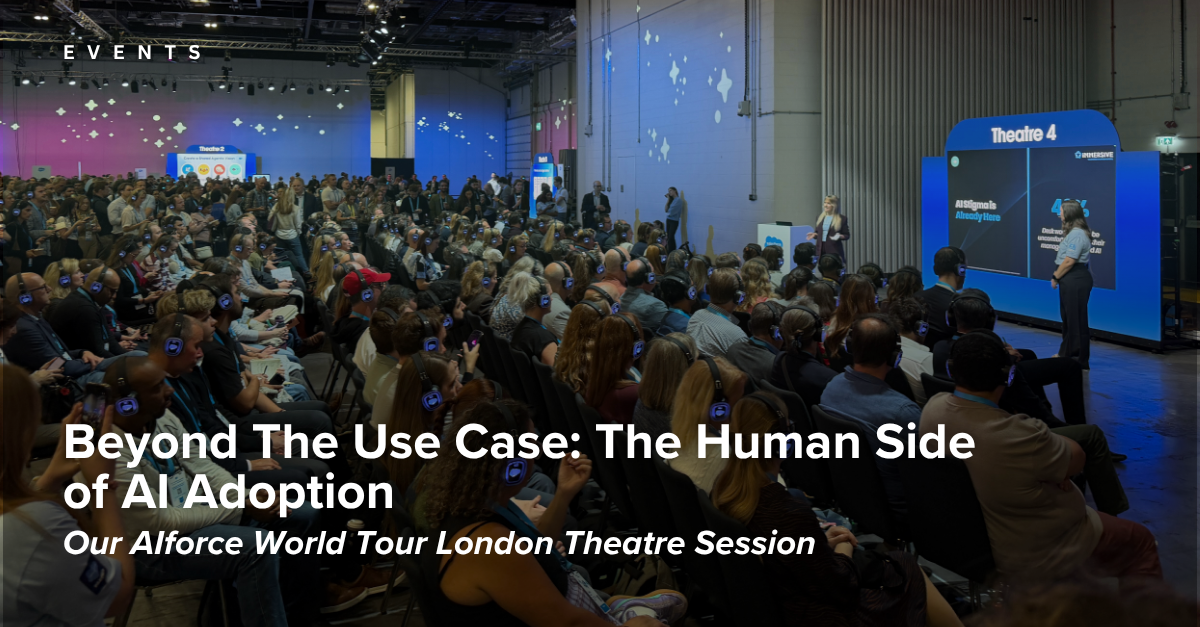
That was the focus of iMMERSIVE’s theatre session at AIforce World Tour London, led by Marcelle Braithwaite, Chief Revenue Officer, and Amy Carlton, Head of Advisory. If you couldn’t make it, here’s a recap of the key takeaways.
The Person Who Taught You Judgement
Amy set the scene, then Marcelle took the room back to their first proper job. She asked everyone to remember the person who looked over their work and said: “That’s nearly right. But here’s what you’ve missed.” She reminded us that we’ve typically learned our roles by doing the job alongside a more experienced colleague reviewed, someone who showed us what we’d missed and helped us develop good judgement.
Now AI is picking up much of that early work: the first drafts, the summaries and the straightforward decisions. That brings real benefits, but it means organisations need to think differently about how their people build experience and adapt.
Where AI’s Value Comes From
They broke down where the value of AI actually comes from.
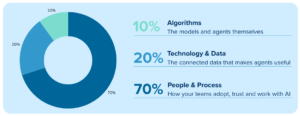
Source: Julie Bedard and Vinciane Beauchene, “AI Transformation Is a Workforce Transformation”, BCG, February 2026
Algorithms account for just 10%, with technology and data adding a further 20%. The remaining 70% comes from people and process, including how teams use AI day to day, how much they trust it and how their roles evolve once agents are in place. Even so, it’s the area AI programmes tend to invest in least.
To close this gap, Amy’s advice was to stop treating AI adoption like a system implementation, and start treating it like a capability and behaviour change programme. In practice, that involves understanding how confident people already are with AI, the AI culture they work in, the skills they need and how their teams will be structured in the future.
Four Places People Get Left Behind
Amy and Marcelle went on to outline four gaps that are limiting the value organisations get from AI.
Gap 1: Same Room, Different AI Maturity
AI confidence within a single team can vary hugely, and without accounting for it, the value stays limited to what the least confident users can achieve.
Gap 2: AI Stigma is Already Here
Nearly half of desk workers (48%) would be uncomfortable telling their manager they’d used AI, because it feels like cheating, and they worry it might make them look lazy or less competent. This means more efficient ways of working often stay hidden instead of spreading across the business. If people don’t feel safe talking about their AI use, organisations can’t learn from it, celebrate it or build on it.
Source: Slack Workforce Lab, “The Fall 2024 Workforce Index Shows Executives and Employees Investing in AI, but Uncertainty Holding Back Adoption”, 12 November 2024
Gap 3: AI Doesn’t Have Taste. People Do.
Around two thirds of people rely on AI output without checking it, and training tends to focus on technical skills like prompting. While the judgement to know when to trust, override or question an output gets far less attention.
Source: GoTo and Workplace Intelligence, “The Pulse of Work in 2026”, GoTo, 2026
Gap 4: Org Charts Haven’t Caught Up
Agents change how work gets done, yet team structures and responsibilities rarely change with them. Where organisations redesign teams deliberately, giving routine tasks to agents and the more complex, human work to people, roles tend to become more rewarding rather than smaller.
Why AI Business Cases Need a People Line
They also highlighted a shift in what leaders are being asked. The focus has moved from whether organisations are using AI to what return it’s delivering. However, most AI business cases still centre on platform and build costs, the areas that account for only 30% of the value. Including budget for the people side, such as training and enablement, AI champions and enough time for teams to learn and adapt, makes it far more likely that the investment pays off.
From AI Mandates to AI Adoption
None of the four gaps are technology problems, and all of them can be closed. Marcelle and Amy shared four shifts we’re seeing work with our customers:
- Segment change by adoption type rather than using a single rollout for everyone.
- The tone starts at the top so open use of AI becomes the norm.
- Invest in soft skills with the same commitment given to technical training.
- Keep the dialogue open about how roles are evolving, starting now.
How each of these is applied depends on where an organisation’s people are today, which is exactly where we can help.
Where the Real Value Lies
Use cases still matter, but their value depends on people feeling heard, supported, trusted, enabled and clear on their role. The session’s closing message was that this needs planning from the start, with engagement and change treated as part of the AI project itself rather than something added at the end.
Helping organisations get this right is what we specialise in. Alongside delivering the technology, our team supports people through the change so the investment delivers real results. If any of these gaps sound familiar, we’d love to chat. Get in touch with our team here, and let’s start the conversation!