The difference between then and now isn’t whether AI is part of your customer experience. It’s how much AI owns.
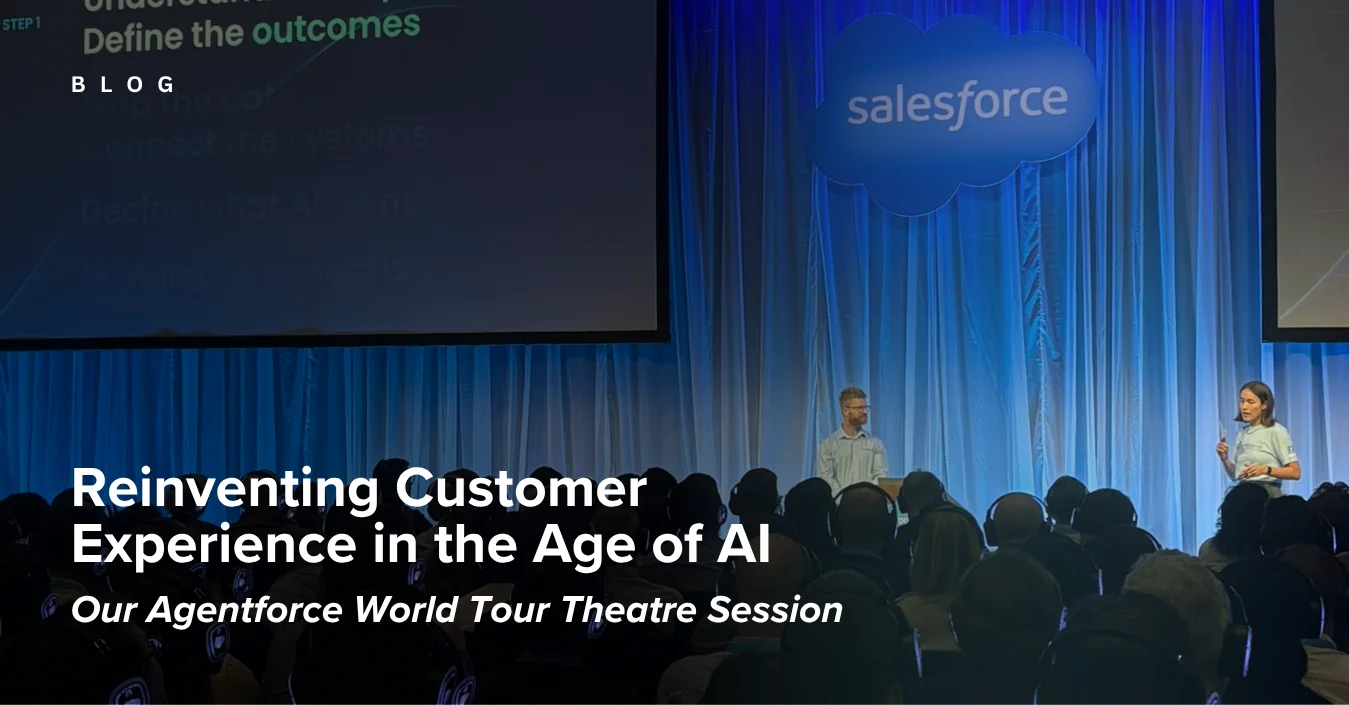
That was the provocation at the heart of iMMERSIVE’s theatre session at Agentforce World Tour London, led by Abi Chan (CRO) and Simon Clarke (Director of AI & Innovation).
If you couldn’t make it, here’s your quick catch-up.
What Makes a Great Customer Experience?
Beneath all the journey maps, NPS scores, and Voice of Customer programmes, great customer experience comes down to three things:
- Customers want to feel understood
- Customers want to have an effortless experience
- Customers want to feel genuinely valued
Lose any of those values and you risk losing the customer, often without them ever telling you why. The tools to deliver those three things have always evolved. AI is the latest shift, and arguably the most significant one yet.
How AI is Changing the Rules
Each new wave of technology has shifted what customers consider normal, and once expectations move, they don’t move back. Behind every previous shift, the telephone, the internet, the smartphone, there was always a human. AI breaks that assumption for the first time, and it changes the game in four distinct ways.
Shift 1: The Customer Isn’t Always a Person Anymore
AI agents are already acting on behalf of buyers, researching suppliers, comparing options, and making decisions. It has been predicted that agent traffic will exceed human traffic online by 2027. These agents don’t respond to great design or compelling copy. They process data structure, and if your information isn’t structured and accessible, you’ve lost the conversation before it even started.
Alongside UX and CX, a new discipline is emerging: AX, or Agent Experience. How your business shows up not to a human, but to an AI acting on their behalf. Most organisations haven’t started thinking about it yet, and the ones that move first will be the ones agents surface, recommend, and act on.
Shift 2: The Conversation is the Product
Customers increasingly don’t navigate to businesses, they ask AI to do it for them. Conversations are already happening in ChatGPT, Claude, and Gemini that most businesses have no visibility into. Salesforce’s Agentforce Experience Layer, unveiled at TDX earlier this year, is designed to solve exactly this, letting you build once and show up consistently wherever your customers already are.
Shift 3: The Agent Economy is Coming
Most organisations are already running AI agents internally, but they’re largely siloed. The next shift is agents working together across internal teams, supply chains, and client systems. The platforms businesses are already running on are building this infrastructure right now, but it requires a level of trust that most business relationships haven’t had to navigate before, and getting the governance and guardrails right will be what separates the businesses that get this right from the ones that don’t.
Shift 4: Trust is the Differentiator
The AI reshaping customer experience is available to every business, and the barrier to access is only getting lower. The technology itself was never going to be the differentiator. What sets businesses apart is the quality of the data that feeds it, the systems that connect it, and the governance that ensures it makes the right decisions.
Agentforce’s observability tools give you a complete audit trail of every agent decision and guardrail check, and MuleSoft Agent Fabric brings that governance into a single place across every platform you run agents on. Because if your people won’t use it and your customers don’t trust it, it’s worthless. Trust isn’t a soft consideration, it’s the differentiator. Not the AI itself. The trust and governance you build around it.
Where Do You Start?
To close their engaging session, Simon and Abi provided four practical steps for businesses ready to move forward:
- Understand the experience. Define the outcomes. Map the journey from your customer’s perspective, find where it breaks down, and define what a genuinely good outcome looks like. Then ask what that’s worth to your business.
- Map the data. Connect the systems. Work out what your agent needs to know at each step, and be honest about how much of that is actually accessible right now. That gap is where the real work begins.
- Decide what AI owns. Not everything should be automated. The key questions: what’s the cost if AI gets it wrong, and can the decision be reversed?
- Design the handoffs. This is where most deployments struggle. When an agent passes to a human, the full context needs to carry across so the customer experience feels seamless throughout.
The psychology of great customer experience hasn’t changed: understood, effortless, valued. What has changed is your ability to deliver it at scale. The businesses that move intentionally, with the right data, the right governance, and a clear view of where AI adds genuine value, are the ones that will pull ahead.
To find out what that could look like for your business, contact our team here.